
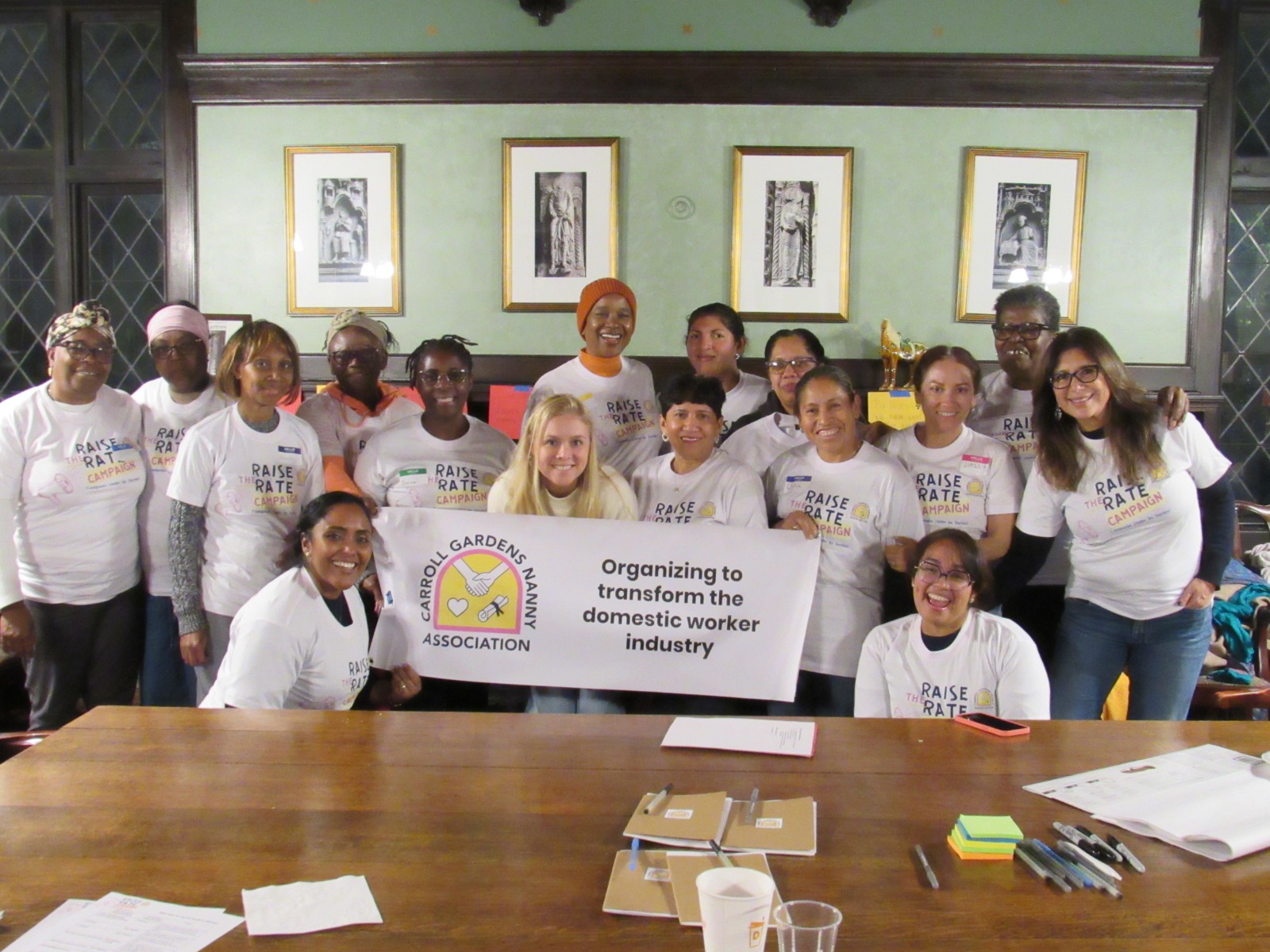
While domestic work in the United States faces historic setbacks and greater precariousness, a group of nannies in New York organized to challenge that reality and defend the value of their work.
Led by the Carroll Gardens Nannies Association, throughout 2025, a group of 25 nannies carried out the Raise the Rate campaign, which sought to achieve an increase in wages. Within weeks, 100% of the nannies who participated in the campaign received a wage increase.
Note: The Carroll Gardens Nannies Association is an affiliate organization of the National Domestic Workers Alliance, La Alianza’s partner organization.
How the campaign began
Raise the Rate was born out of the collective work of nannies who decided to organize, share tools, and support each other to change the conditions of a historically invisible job.
The campaign was built on listening. Through the Nanny Dignity Project, a project of the Carroll Gardens Nanny Association, 391 surveys were conducted with nannies, asking about wages, working hours, overtime pay, time off, sick leave, contracts, and basic working conditions.
The project revealed that most nannies faced low wages and did not know how to negotiate better conditions.
From data to collective action
When the survey project ended in July 2025, a group of 25 nannies got together to decide what they wanted to change. Although many demands came up, like bonuses, paid time off, and sick leave, the priority was pay. That’s how Raise the Rate was born.
“Negotiation was the key issue,” Sharon Best, one of the campaign organizers, explained to La Alianza. “Many of them were afraid and didn’t know how to negotiate professionally, despite their experience.”
The workers participated in workshops, face-to-face meetings, and Zoom calls. They practiced scripts, role-played, and shared their own experiences and fears.
“They received training and scripts to help them have one-on-one conversations with employers,” says Sharon. “Not aggressive conversations, but confident conversations.”
The nannies learned to explain their rates based on their experience, training, and responsibilities. They learned that caring for one child has a base rate, that a second child means an increase, and that overtime begins after 40 hours per week. They learned that breaks, taxes, and overtime must be clearly stated in a contract.
Those who were already earning $30 or $40 per hour supported those who were earning less, demonstrating that these wages were possible.
The result was overwhelming: after negotiating with their employers, all 25 nannies achieved wage increases within three to four weeks. Those who earned $15 per hour negotiated $20 per child and 5% or 10% for each additional child, depending on their skills and education.
“It was a great success because we worked as a team, listened to each other’s fears, and helped to strengthen each other’s confidence and self-esteem,” says Sharon.
Overcoming fear
For many of them, immigrant women, overcoming their initial fear was a challenge, especially in the current political climate, says Wendy Guerrero, Program Coordinator for the Carroll Gardens Nanny Association.
“Now many fear the political situation,” says Guerrero. “[Many] told us, ‘I can’t join, I want to, but my employer said he would fire me if I joined you… We have received cases where they tell us, ‘My employer has told me that he wants to pay me this [less] and if I don’t accept it, he will call ICE on me.’”
How to negotiate: the tools of the campaign
Part of the campaign’s success lay in transforming negotiation into something concrete and applicable. The nannies not only learned that they could ask for more, they learned how to do it.
“If an employer asks me my rate, I say $45, even if my goal is $40,” explains Sharon. “And if they want me to clean, cook, or take on additional tasks, that’s my rate given my training and responsibilities.”
This campaign taught that negotiating is not just about money, but also about long-term protections. For nannies who want a raise but have a contract, Sharon recommends including reviews every three to six months.
“When the contract is renewed, that’s the time to ask for a raise,” she says. “It’s not personal, it’s part of the agreement.”
Although it is possible to negotiate without a contract, the campaign was clear that a contract is essential.
“Without a contract, one day the employer can say, ‘We don’t need you anymore,’” Sharon explains. “With a contract, they owe you advance notice and compensation. With a contract, they must [give] notice and severance pay.”
Thus, this campaign not only increased wages but also raised standards for domestic work.
“Being a nanny is a professional job,” Sharon says. “If you don’t value your nanny, you don’t value your child. Your child is the most valuable thing you have.”
Editor’s note: This article was originally written in Spanish and translated into English