
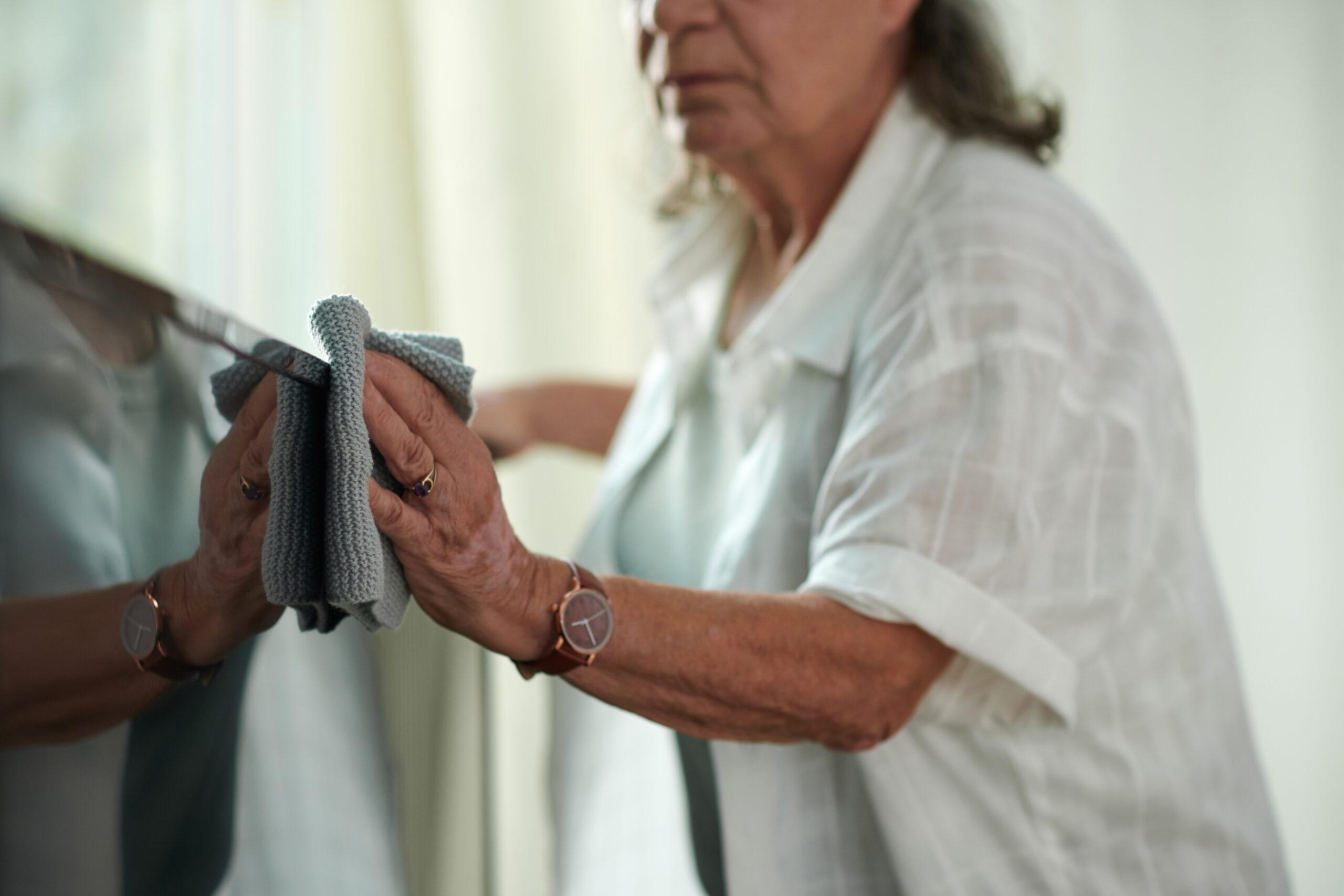
At 66, Araceli Herrera still cleans houses. She arrives at one of them around 8:00 a.m. and leaves at 2:00 p.m. She earns $200 for those six hours. She says the women she works for are kind to her. They don’t pay her well, she clarifies, but they’re kind. For now, her body can still handle the work, she says. And she has to keep going, because Araceli has already done the math on her retirement, and the money won’t be enough.
Last year, when she turned 65, Araceli says she received information from Social Security stating that if she started collecting her benefits at that time, she would receive about $600 a month.
“I said no, because $600 isn’t enough for me,” she told NDWA. So she kept working.
Few have retirement benefits through their jobs
Araceli has been a domestic worker since 1992. She has cared for the elderly, worked as a nanny, and cleaned houses. For decades, she also cared for people with mental health issues. She says that was the hardest job she ever had. She worked at night and had to stay overnight in the house to care for three women with various mental health conditions, including schizophrenia and severe depression. Her bed was in the living room, and on her employer’s instructions, she had to keep the TV on.
She still remembers her first night on the job. She fell asleep in the living room, and at some point, she opened her eyes and saw the three women standing around her bed, watching her. “Oh my God,” she thought. “Are they going to kill me or something?” Nevertheless, she continued working there. They paid well, and she needed the money. Araceli says that during those years, her wages were reported to Social Security, so that job contributed to the retirement benefits she is now eligible to receive.
In many of the other jobs she held, the story was different.
Araceli worked for decades as a housekeeper for the same families—20 years with some, 25 with others. She even worked for one of them for about 30 years. But the length of that employment relationship didn’t necessarily translate into security in her old age. “Employers aren’t going to give you anything,” she says.
The Numbers
Of the 2.2 million domestic workers in the United States, only 9.1% have a retirement plan provided by their employer, according to an estimate by the Economic Policy Institute (EPI). Of these, only 2% of housekeepers and 3.5% of nannies have this type of benefit. Among care workers hired directly by a family, the figure is 6.6%, while among those working through an agency, it reaches 13.1%.
Additionally, when work is paid informally and wages are not reported, that income may not be recorded for Social Security purposes. In 2026, an employer who pays at least $3,000 in cash during the year to a domestic worker generally must pay and withhold the corresponding Social Security and Medicare contributions.
A Retirement Plan Based on the Little She Has
After more than three decades of work, Araceli’s retirement plan—she has one son but lives alone—consists of her small Social Security check, some money she’s managed to save over the past four years, and the idea of moving into an inexpensive apartment. She says she has met other older domestic workers who live that way. They pay low rent and utility bills in shared apartments. Araceli thinks that when she can no longer clean houses, she’ll look for one of those places in San Antonio because she doesn’t want to be a burden on her son.
“That’s where I’m going to go live,” she says. Although she doesn’t know when that will be. She doesn’t talk about a retirement date but rather a physical limit. “As long as my body holds out,” she says. That same body that has been a tool of her trade for more than thirty years.
Who Will Take Care of the Caregivers?
Araceli’s biggest concern about growing old isn’t just running out of money. It’s the thought that one day she might need the very thing she has provided for much of her life: care. “I’m worried that I’ll be alone,” she says. “I hope I won’t need special care, that I’ll have someone to help me, and that I’ll be able to afford to pay someone to help me.” And her concern is not unfounded.
Araceli has already seen what can happen when a domestic worker grows old without enough resources. She tells of colleagues who worked for years and who, as they grew older or fell ill, returned to their home countries just “to die,” she says. Some had earned too little to save for retirement or sent most of their wages back to their families. This problem also affects in-home care workers.
A UCLA study of this workforce in California found that 74% of those surveyed had no personal savings for retirement. More than half were 50 years old or older, and 63% said their income wasn’t enough to cover their household expenses.
That’s why, when Araceli thinks about the workers coming after her, she advises them to know their rights, understand how the retirement system works, save whenever possible, and take care of their health. “Knowing how to stand up for yourself is a powerful tool for survival,” she says. Araceli can still work. She still has energy. She can still walk into a house at eight in the morning, clean for six hours, and walk out with $200. And she’ll only retire when her body decides it can’t go on anymore.
Editor’s note: This article was originally written in Spanish and translated into English by Tilde Language Justice Cooperative