Domestic workers in Washington State have achieved a historic milestone: they now have the same labor protections as other workers. The state legislature passed the Domestic Workers’ Bill of Rights, which aims to ensure basic labor standards for nannies, in-home caregivers, housekeepers, gardeners, and cooks.
The law establishes basic rights such as minimum wage, written contracts that specify duties and pay, and clear guidelines against harassment and abuse in the workplace.
The new law was signed by the governor on March 9 and will take effect on July 1, 2027.
The measure is part of a nationwide movement to address decades of exclusion of these workers from key U.S. labor laws.
What does the new law in Washington establish?
The bill, known as House Bill 2355, establishes a clear legal framework for domestic workers throughout the state. The legislation was sponsored by State Representative Brianna Thomas of West Seattle.
The main protections include:
- Ensuring a state minimum wage and overtime pay for work exceeding 40 hours per week.
- Requiring written contracts that include details on pay, hours, and benefits, in a language that both parties understand.
- Requiring employers to give advance notice before dismissing an employee (two weeks, or four weeks for live-in workers), or to pay severance pay.
- Prohibiting hostile work environments, taking personal belongings, or monitoring an employee’s private activities.
- Prohibiting contracts that require disputes to be resolved outside of court, require employees to remain silent about workplace issues, or prevent an employee from working for another employer.
- Establishing protections against retaliation when workers assert their rights.
- Allowing for the investigation of complaints and the imposition of fines on employers who violate the law, as well as prohibiting discrimination against domestic workers.
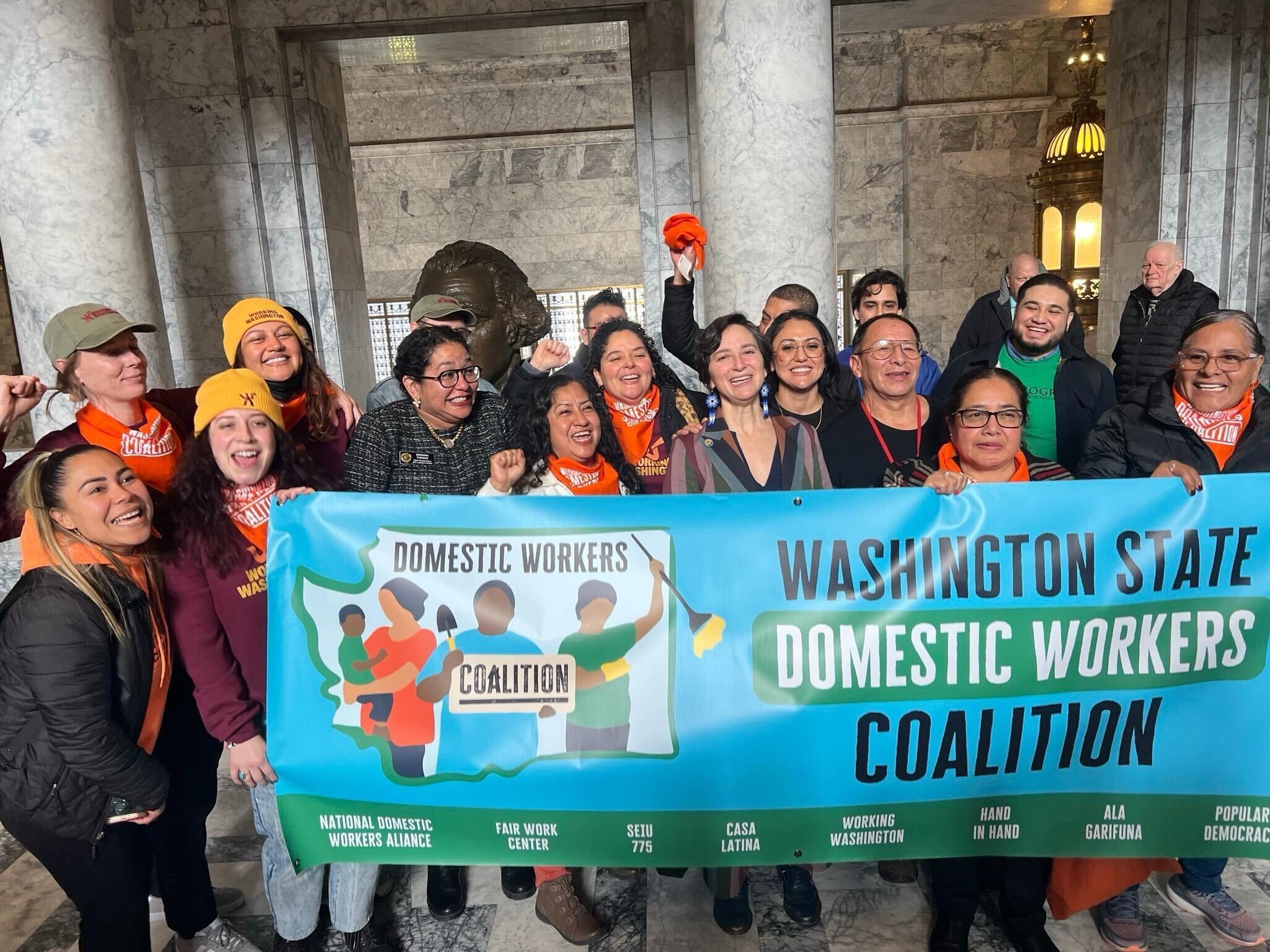
The legislation is the result of years of work by a coalition of organizations, including Casa Latina, the Fair Work Center, Hand in Hand, and the National Domestic Workers Alliance, among others.
According to this coalition, these protections will benefit approximately 100,000 domestic workers throughout Washington State.
Note: The National Domestic Workers Alliance is the partner organization of La Alianza.
A sector that has historically been excluded from labor laws
Domestic workers have historically been excluded from many labor protections in the United States. When key labor laws were enacted in the 1930s—such as the Fair Labor Standards Act (FLSA) and the Social Security Act, domestic workers were excluded from several provisions.
Historians and labor policy experts point out that this exclusion was driven by political, racial, and gender-based motives. Lawmakers from the South pushed for these exemptions to exclude occupations predominantly held by Black women, thereby perpetuating a low-wage labor system tied to the racial hierarchy of the Jim Crow era.
In recent decades, labor and community organizations have pushed for reforms to address these structural inequalities.
A growing national movement
With this legislation, Washington joins 12 other states that have enacted similar laws: California, Connecticut, Hawaii, Illinois, Massachusetts, Nevada, New Jersey, New Mexico, New York, Oregon, Rhode Island, Virginia.
At the local level, the city of Seattle was one of the first to pass such a regulation in 2018, although its scope was limited primarily to King County. Bills of rights have also been passed in Philadelphia and Washington, D. C.
Editor’s note: This article was originally written in Spanish and translated into English by Tilde Language Justice Cooperative.