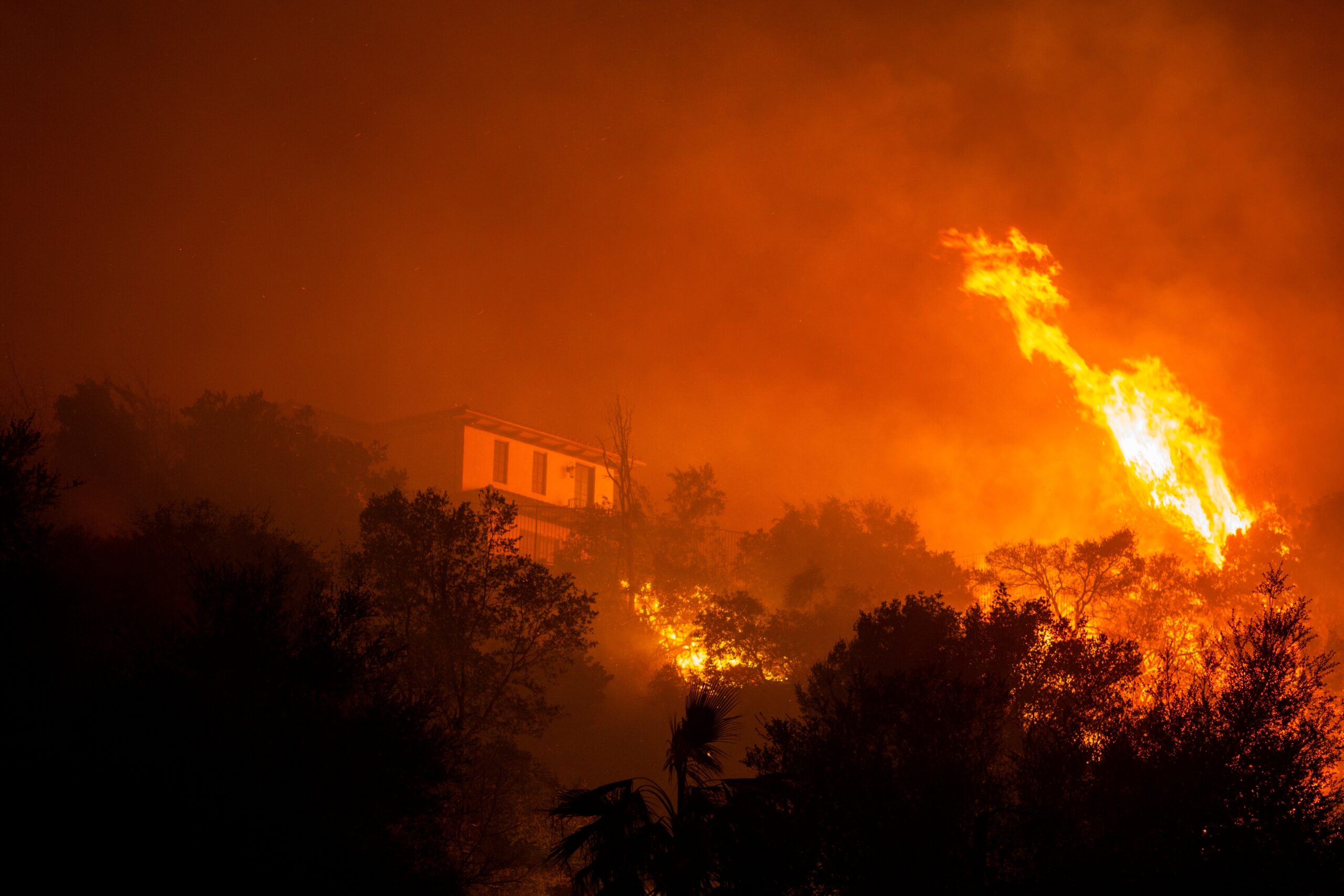
California—Wildfires have once again put several California communities on alert. For many domestic workers, this can also mean facing risks that aren’t always visible, such as exposure to smoke, ash, and other pollutants left behind by a fire.
After the 2025 fires in Los Angeles, many homes remained standing but were covered in ash, soot, and other debris. Hundreds of workers, including domestic workers and day laborers, took part in the cleanup and recovery efforts.
A study conducted by the University of California, Los Angeles (UCLA), the Institute of Popular Education of Southern California (IDEPSCA), and the National Day Laborer Organizing Network (NDLON) found that cleaning up ash, soot, and debris was one of the most common tasks following the fires.
The researchers also documented that workers who participated in the cleanup were exposed to chemical and physical hazards, that access to personal protective equipment varied by employer, and that many reported respiratory tract irritation.
In the wake of these fires, California strengthened health and safety protections in 2025 for those who clean up fire-damaged homes.
In this guide, we explain what those protections are and what questions you should ask before accepting a job involving this type of cleaning.
Know Your Rights
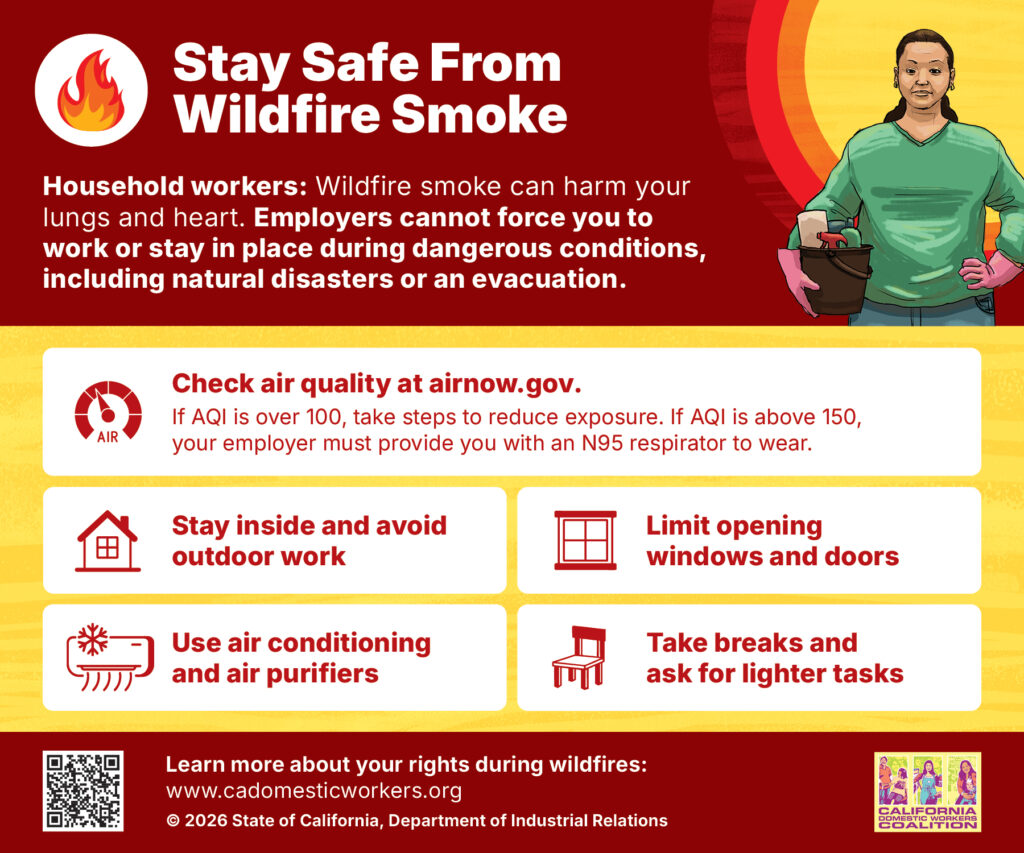
If you work in California during fire season, keep this official guide from the Department of Industrial Relations.
Once authorities allow people to return to a fire-affected area, some domestic workers receive calls to help clean up homes.
If this applies to you, it’s important to know that not all tasks pose the same risks. When the job involves cleaning up ash, soot, or debris, special safety rules may apply.
In addition, California law protects workers when conditions pose a hazard. These protections include:
- An employer may not require an employee to enter or remain in an area subject to a mandatory evacuation.
- Employees may refuse to report to work or may leave a workplace when they reasonably believe there is a danger due to a disaster.
- The law also prohibits retaliation against employees who exercise these rights.
The California Division of Occupational Safety and Health (Cal/OSHA), states that these workplace protections apply regardless of a worker’s immigration status.
What if the House Didn’t Burn Down, but Was Covered in Ash?
According to Cal/OSHA, cleaning a home under these conditions may no longer be considered ordinary housekeeping.
If the job involves removing ash, soot, and debris or cleaning a structure damaged by fire, it may be considered post-fire cleanup. This type of work is protected by California’s health and safety regulations.
Before returning to work, Cal/OSHA recommends making sure the site is safe and that the employer has identified any workplace hazards in advance.
Based on that guidance, here are some questions you can ask before accepting a job at a home affected by a fire:
- Is there an evacuation order for that area?
- What is the air quality like today?
- Does the home have ash, soot, or visible damage?
- Will I be provided with a mask and the necessary protective equipment?
- Are you asking me to do tasks that are different from the ones I normally do?
If you’re unsure about the conditions at the site or the tasks you’ll be performing, ask for more information before you start.
Check the Air Quality Before Heading out
Before heading out to work, check the Air Quality Index (AQI) at AirNow.gov. If the AQI reaches 151 or higher and Cal/OSHA standards apply to your workplace, the employer must take steps to reduce exposure to smoke. If necessary, you should also provide respiratory protection, such as N95 masks.
To find out if health and safety regulations apply to your workplace, we recommend reading our article: How to Tell If California’s Workplace Safety Law Protects Your Job
An N95 Mask Isn’t Always Enough
An N95 mask helps reduce exposure to smoke and ash particles, but other protective measures may also be necessary when cleaning a home affected by a fire.
The U.S. Environmental Protection Agency (EPA) recommends wearing gloves, eye protection, long-sleeved shirts, long pants, and closed-toe shoes to avoid contact with ash and other fire debris.
If the job involves removing ash, debris, or burned materials, ask your employer what protective equipment they will provide so you can perform the work safely.
The Most Important Thing Is to Protect Your Health
Organizations such as Hand in Hand point out that many female workers continue to work during fires because they fear losing a customer or depend on that income to support their families.
However, your safety must be the priority. If there is an evacuation order, the air quality is hazardous, or the home has fire damage, find out about the conditions before entering and ask any necessary questions.
Knowing your rights and talking to your employer about the risks can help you protect your health.
Useful Resources
- AirNow.gov: A tool to check the Air Quality Index (AQI) before leaving home and see if there is smoke in your area.
- California Department of Industrial Relations (DIR) / Protection from Wildfire Smoke: Information in Spanish about California regulations to protect workers exposed to wildfire smoke, how to report hazards, and related materials.
- Cal/OSHA / Safety and Health During Post-Fire Cleanup: Guide on the risks of cleaning fire-damaged homes, personal protective equipment (PPE), and employers’ obligations during cleanup operations.
- California Domestic Workers’ Coalition: Resources, campaigns, and information on the rights of domestic workers in California.
- Hand in Hand / Disaster Preparedness for Employers and Domestic Workers: Recommendations for preparing for a fire, communicating during an evacuation, and protecting the health and safety of female workers.
Editor’s note: This article was originally written in Spanish and translated into English by Tilde Language Justice Cooperative